

Rites of Passage

The summer I graduated from high school I split my time between rural New Jersey and New York City. In New Jersey I worked at a sawmill. In New York I bummed around the beaches on Long Island during the day and played gigs in the city’s Irish bars at night. I remember many sunny days enveloped in cigarette smoke and salt water, body surfing off Long Beach and passing for twenty-one years old in the bars where I played shows.

The next summer, after one year of college, I spent with a band out in Seattle. We would busk in the streets or at Pike’s Place Market during the day and would pack the pubs at night with crowds ready to dance to our fairly raw and raucous sound. The tips came in the form of pitchers of beer and phone numbers scrawled on napkins.
The summer after that, I traded my guitar for a gun and spent months crawling in the dirt in Southern California alongside hundreds of other young men who were intent on becoming United States Marines.
To my musician’s ear, the first morning of boot camp truly registered as a different universe—one I had no experience of despite having attended an all-male boarding school, travelled pretty widely for a kid, and done some unusual things (like living off the streets in Rome as a member of a juggling troupe). But this was entirely different.
After the initial terrifying introduction to bootcamp, which occurs the day you arrive and is conducted by gnarled and tattooed Marines with impossible stamina and voices like ice picks—they make it clear that they despise, disrespect, and intend to harm you every way they can—we eventually found ourselves trying to fall asleep in a cavernous hall in metal bunks while the fatigue and adrenaline from hours of screaming, running, pushing and shoving, wrestled for the upper hand.
But it was the sound of the morning that told me the portals between the old world I had come from, and this new one I had chosen, were slammed shut. Our drill instructors had not yet come for us that morning, but as I lay in my rack, I heard at various points of the compass around me the powerful, foreign sound of hundreds of voices resonating in sharp, decisive unison, at the top of their lungs. At first I couldn’t tell what those massed voices were barking, but as the days passes and the rag-taggle group of recruits of which I was a member began to take on the same form as those ahead of us in training, it became clear that these were responses to commands: “yes sir,” “no sir,” “aye-aye sir,” and most of all that universal assent to a command in the Corps: “KILL.”
The pain in bootcamp is mundane. If you’re in decent shape, it’s not a problem. Too little sleep, too little time to eat, physical training, exposure to the elements, and combatives comprise the physical pain. For those who have never experienced elite military training, physical suffering is often top of mind. In my experience, it does exist, but most people could endure it with the right attitude. In the operating forces, we trained to a much higher level of physical suffering than in bootcamp.
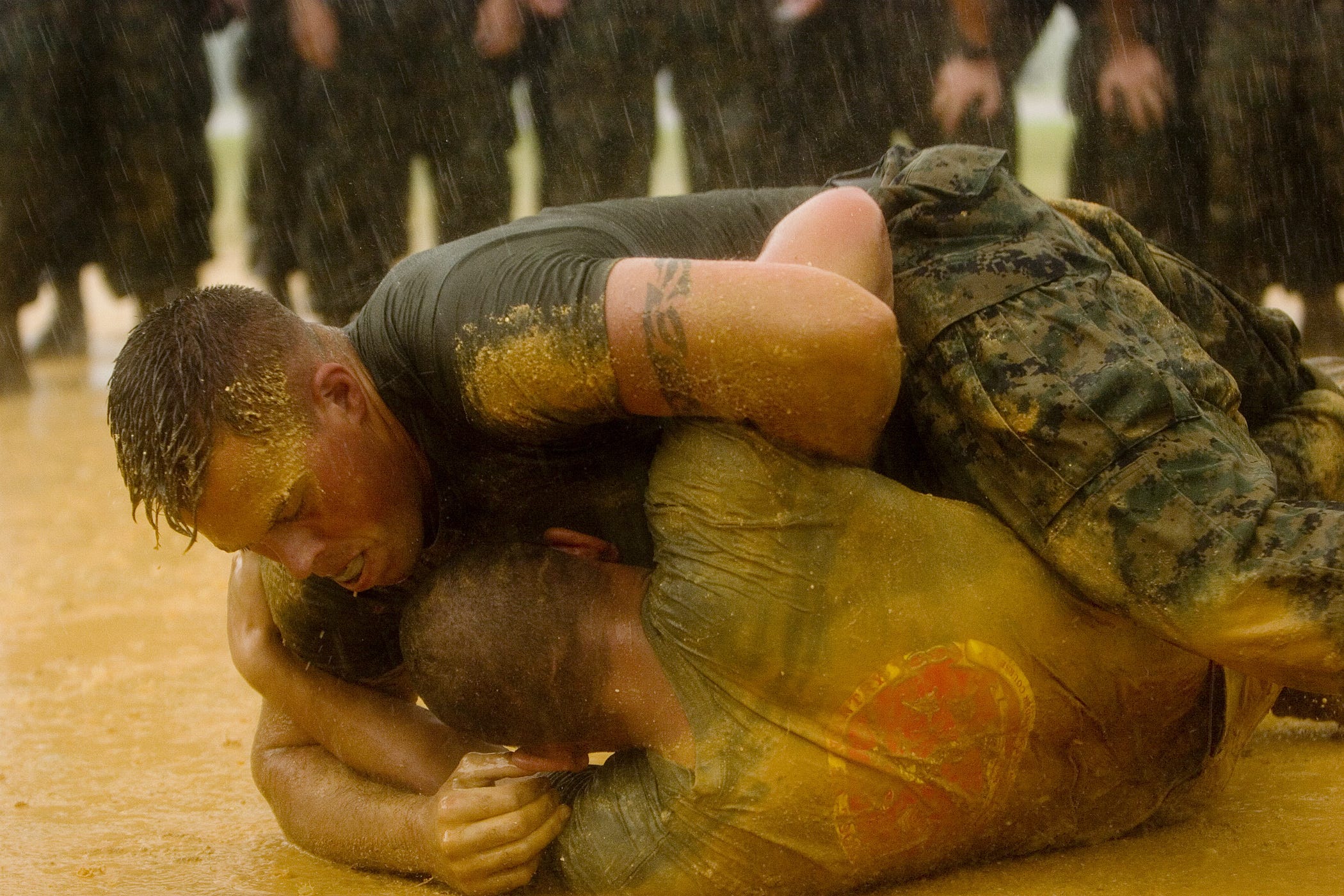
What is much more thorough and impactful, however, is the sustained humiliation. There are other elements to martial formation aside from physical pain and humiliation: acclimation to responsibility; membership on a team; institutional ethos and esprit d’corps, technical mastery of weapons, etc. All of these need to happen, but humiliation is like a good marinade before searing the meat. It makes it pliable for the work to come. The forms of humiliation are many and ingenious and probably contribute the most to a young man’s martial formation.
You eat and sleep and exercise all bodily functions like an animal on the run. You have no first name and if you find yourself having to communicate with a drill instructor, you must only use the third person to refer to yourself. There is no “self” now…just another Marine recruit among many. The armor, weapons, and equipment one trains with are so old, shabby, and ill-fitting that any sense of pride quickly gives away to a humiliating grind. One is never spoken to—always screamed at. Eye contact with real Marines is forbidden. Any infraction is rewarded with physical pain and degradation, and sometimes an added psychological element if you do something stupid: you might have to write letters to your fellow recruits’ mothers, wives, and children to explain why your selfishness, incompetence, weakness, or stupidity has caused their son, husband, or father to die unnecessarily.
If politicians had a boot camp to qualify them for service, I’d recommend this last exercise in particular.
To succeed in this environment requires negotiating a sustainable truce between your fear of pain and humiliation, your resentment at being forced into those feelings, your own disgust with yourself for feeling them in the first place, and a prudence which keeps your goals in sight while your humanity is disassembled and reassembled around you.
It’s brilliant.
I consider often how martial formation and basic formation as a man are related. Martial formation requires a quick and thorough development of certain virtues which are difficult to develop with any dependability among young men. They need fortitude, selflessness, aggression, capacity for violence, dependability, and the ability to follow orders decisively but also imaginatively. It seems to me these martial qualities—while not coextensive with all the qualities of a good man—are all present in a good man.
I’ve noticed that the approach to forming Marines (you might consider it an approach necessary for forming good men in general) exhibits a structure which appears throughout history in various rites of passage. Take Xenophon or Herodotus when they describe the formation of Persian youth, or consider the Christian monastic novitiate, chivalric procedures for knighthood, or the native American vision quest or huskanaw. The path to full, adult manhood, requires pain, responsibility, and humiliation.
There is a deep sensibility in this path—deeper, I think, than simple expressions of this or that different culture’s values. I suspect it corresponds fundamentally to our anthropology—one seen clearly inscribed in Christianity’s account of salvation through a God who lowered Himself to our level and then suffered.
The structure is hyper-legible in the ancient rite of the Roman Catholic Mass, used continually for nearly two thousand years. The priest, representing his people, can only approach the altar by lowering himself. The opening psalm of the ancient Mass is a poem of pain and penance called colloquially, the “prayers at the foot of the altar.” It is recited by the priest at the bottom of the steps approaching the altar, at times bent double in humiliation. “Judge me, oh God,” says the priest before continuing, “why hast thou cast me off?” You’ll notice that the form imitates Christ’s mission on earth and seeks to follow Him by implicating all the congregation in the process of humiliation and sacrifice.
This structural consonance of the Mass with our anthropology is not an accident, I suspect, but a formal parallel… one of the ways in which the ritual is metaphysically correct and educative. The Church’s central act of worship reenacts Christ’s life and because both His life, and the Church’s reenactment correspond to all our lives, they illuminate and instruct. At least, they used to. As with the general culture which no longer values pain, humiliation, and responsibility as essential ingredients in masculine formation, so too has the Church, only very recently in its long history, altered the ritual to remove the gradual approach to the altar, the pain-filled psalm, and the physical postures of humility which once guarded the altar.


The new ritual, like the general cultural, prefers a therapeutic approach focused on speech. In this way it is much more abstract and intellectual than the Mass that formed the faithful for millennia. In education (formation of the young) as in the liturgy, we now place a premium on talking about things rather than forcing ourselves, however uncomfortably, into metaphysically correct postures.
After that alcohol-dimmed, smoke wreathed summer in New York City, the next time I hit the beach was as an infantry Marine, at midnight in the frigid Pacific. As I crawled from the water through the sand to create a perimeter around our zodiacs, I fumbled with numb hands to keep my SAW (Squad Automatic Weapon) out of the sand, knowing that if I failed, there would be hell to pay.
This kind of thing happened daily back then. I spent over a decade in the Corps, and though I little understood it at the time, I think now that I was fortunate to be participating in one of the ancient, durable, rites of formation.
Thanks for sharing this story--really great perspective here.